Get in touch
The reality of working as a Station Manager in an Amazon DSP operation: the 5:45 AM alarms, the 10 PM finishes, the responsibility, the sacrifices, and the management practices that eventually made me walk away.
The Job Wasn't What Broke Me. It Was Everything Behind It.
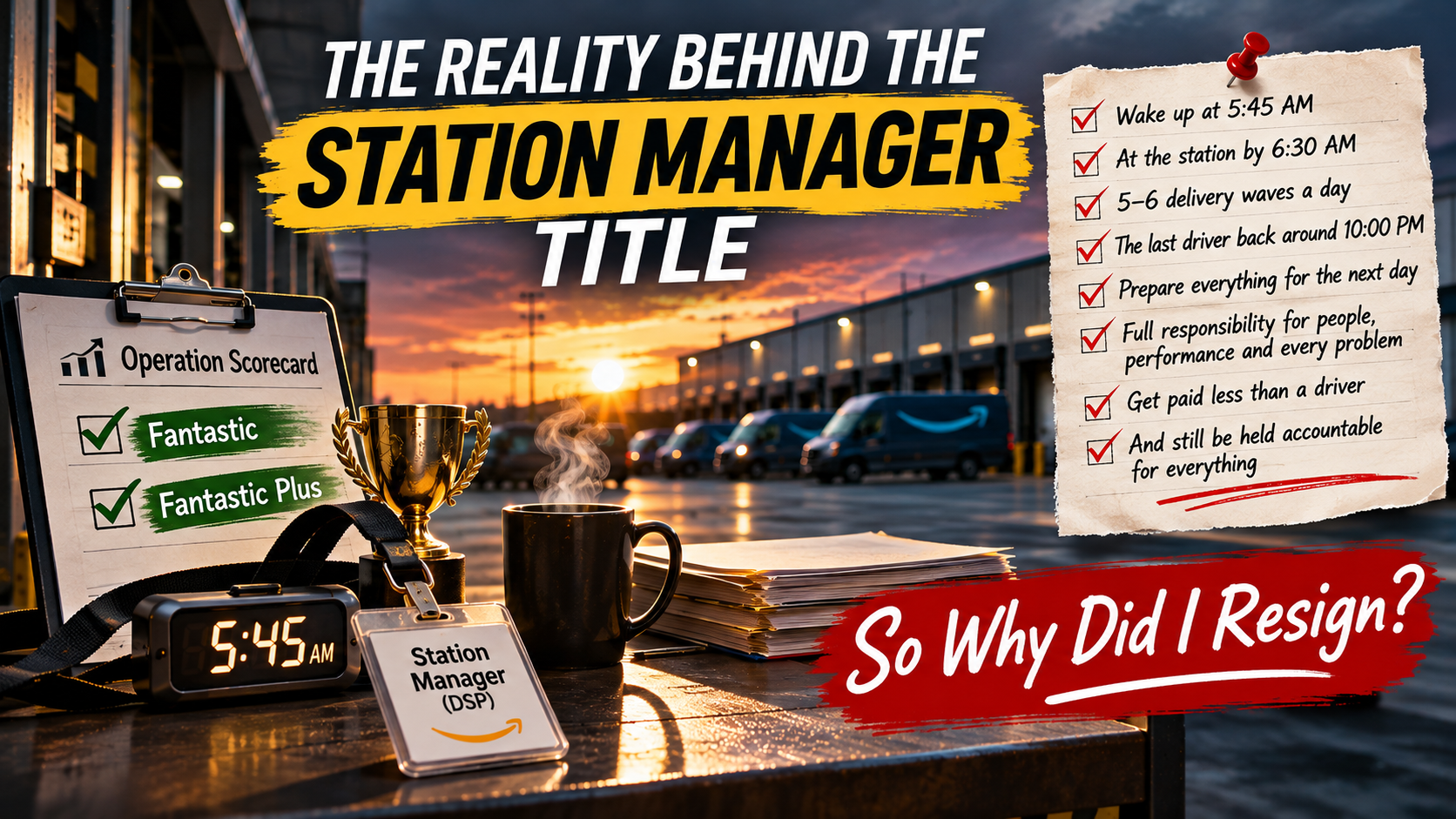
The reality behind the Station Manager/Dispatcher title: 16-hour days, operational pressure, outstanding scorecards, personal sacrifices, and the things nobody talks about.
People often see a job title and assume they understand what the job involves.
Station Manager.
It sounds like a position of authority. A leadership role. A person who manages a station, coordinates operations, supervises teams, and makes sure everything runs smoothly.
But very few people understand what actually happens behind that title.
And even fewer understand what it can cost you personally.
I want to tell my story. Not because I want sympathy, and not because I want to discredit an entire industry. I want to talk about the reality of working in an Amazon Delivery Service Partner (DSP) operation, from the perspective of someone who experienced the responsibility, the pressure, the sacrifices, and eventually, the reasons that made leaving the only reasonable decision.
And I want to start with the alarm clock.
5:45 AM. The day begins before most people wake up.
My alarm would go off at 5:45 in the morning.
While most people were still sleeping, I was already getting ready for another working day.
By 6:30 AM, I was expected to be at the station.
Not at 8. Not at 9.
6:30 AM.
The operation had to start, drivers had to be coordinated, routes had to be organised, problems had to be anticipated, and the first wave had to be ready to go.
There was no luxury of arriving slowly, having a coffee, and gradually getting into the working day.
The day was already happening.
Drivers were arriving, questions needed answers, operational issues needed solutions, and every minute mattered.
We had five or six dispatch waves throughout the day, with drivers heading out on their Sameday/NextDay routes and the operation moving continuously from one wave to the next.
And if you think that once the last wave had left, the difficult part was over, you would be wrong.
That was only one part of the day.
From the first driver to the last one. Sometimes until 10 PM.
A Station Manager's day doesn't necessarily end when the office gets quiet.
It doesn't end when the majority of drivers have left the station.
And it certainly doesn't end when someone decides that their own working hours are over.
You have to keep track of the operation, deal with escalations, support drivers, communicate with drivers, resolve unexpected situations, and make sure the entire delivery process continues.
Some drivers finish earlier.
Others encounter delays, problems on their routes, difficult delivery situations, or circumstances that cannot be predicted at the beginning of the day.
And you wait.
You follow up.
You solve problems.
You make sure the last driver gets back.
Sometimes, that means waiting until 10 PM for the final driver to finish.
And even then, you are not necessarily done.
Because tomorrow is coming.
And tomorrow needs to be prepared before you can finally leave today behind.
Routes, staffing, operational planning, pending issues, communication, documentation, and everything else that needs to be in place for the next morning.
You finish one day while already preparing for another.
Think about that for a moment.
Wake up at 5:45 AM. Arrive at the station at 6:30 AM. Manage five or six waves. Deal with the operation throughout the day. Wait for the last driver until approximately 10 PM. Prepare everything for the following day.
And then go home.
Only to repeat the entire process a few hours later.
This was not an occasional exceptionally difficult day.
This was the reality I experienced.
Responsibility without a corresponding reward
One of the most difficult things to accept was the financial reality of the position.
You carry responsibility for an entire operation. You are expected to coordinate people, manage performance, solve problems, take decisions, handle escalations, and be accountable when something goes wrong.
You are expected to think like a manager, act like a manager, and be available like a manager.
Yet, despite all those responsibilities, I was paid less than a driver.
Let that sink in.
Someone responsible for coordinating the operation, managing several dispatch waves, supporting the team, and ensuring that the entire station functions properly was earning less than someone working as a driver.
There is nothing wrong with being a driver. Drivers do demanding work and deserve fair compensation.
The problem is the imbalance between responsibility, working hours, expectations, and financial recognition.
You cannot continuously demand management-level commitment while treating the person in that position as though their time and responsibilities have little value.
And that brings me to something else.
Being held accountable for absolutely everything.
When everything is your responsibility
When operations run smoothly, that is often considered normal.
When targets are achieved, people look at the numbers.
When the scorecard is good, it becomes just another expected result.
But when something goes wrong, suddenly everyone wants answers.
A driver has an issue? You are responsible.
A route doesn't go according to plan? You are responsible.
An operational problem appears? You are expected to solve it.
Something happens outside your direct control? You still have to explain it.
You are expected to take responsibility not only for your own decisions but sometimes for circumstances that you cannot control.
And you learn to live with that pressure.
You become the person who has to find a solution, regardless of the circumstances.
You become the person who cannot afford to have a bad day because everyone else is depending on you.
You become the person who keeps everything moving.
And for a while, I did exactly that.
I showed up. I delivered. I took responsibility.
But the hardest part of my story wasn't the working hours, the early mornings, the late finishes, or even the salary.
Those were things I could see, understand, and, to a certain extent, accept.
The hardest part came from the management side.
The part nobody wants to talk about: management practices
There is a difference between working in a demanding environment and working in an environment where you feel that the rules are not applied fairly.
A demanding job can challenge you.
A difficult operation can test your patience.
But when you start questioning the transparency, integrity, and fairness of the people managing the business, something changes.
And that is where my experience became particularly difficult.
I had worked hard to achieve strong operational results. Our scorecards were consistently among the top-performing ones, with excellent results, including Fantastic and Fantastic Plus performance.
These were not achievements that happened by accident.
Behind those results were long working days, decisions made under pressure, constant communication, problem-solving, coordination, and a lot of personal commitment.
I knew how much work had gone into achieving those results because I was there.
I lived it.
And yet, despite those results, despite the commitment, and despite the responsibility I had taken on, I found myself in a situation where the manager was asking me to resign.
Think about the contradiction.
You work hard to deliver outstanding results. You help maintain an operation that performs at the highest levels. You sacrifice your personal time and give everything you have.
And instead of feeling that your work is recognised, you find yourself being pushed towards the exit.
That raises a very uncomfortable question:
If the results are excellent, what exactly is the problem?
Is it performance?
Is it capability?
Or is it something else entirely?
I cannot speak for other people's intentions. But I can speak about what I experienced and how deeply it affected my trust in the management of the business.
When even your employment documents become a problem
There were also issues that went far beyond operational management.
My employment contract was taken from the office.
I was not being provided with my payslips.
And I experienced salary deductions that, from my perspective, were not properly justified or explained.
These are not minor administrative inconveniences.
An employment contract is a fundamental document. A payslip is not a favour that an employer grants when they feel like it. And deductions from someone's salary should have a clear, lawful, and transparent basis.
When you work extremely long hours, carry significant responsibilities, and give so much of yourself to a company, the minimum you should be able to expect is transparency regarding your employment and your pay.
You should not have to chase basic employment documentation.
You should not have to wonder why money has been deducted from your salary.
You should not feel that asking questions about your own employment rights makes you a difficult employee.
And you should never feel pressured to resign simply because you expect to be treated fairly.
These experiences made me question not only the management decisions but the culture behind them.
To me, they represented a serious failure of transparency and accountability.
And no operational scorecard, no matter how impressive, can compensate for that.
I sacrificed weekends, missed important moments of my life and showed up even on the days when I was barely holding myself together.
I gave everything I had.
Till there was almost nothing left to me.
And when I finally had nothing more to offer, I realised something painful.
Most of the time people don't value you.
They only value what you can do for them.
It feels like a candle. Being a candle means you can shed lights to others.
But when you're all exhausted, when you have nothing left to give, you're no longer needed, they will just simply blow you away.
One Job Title. Four Different Jobs.
There is something else people need to understand about my experience.
I was not simply working as a Station Manager.
In reality, I was performing several different roles, often at the same time.
I was a Dispatcher, coordinating drivers, managing dispatch waves, monitoring routes, dealing with operational issues, and making sure deliveries started and progressed as expected.
I was a Station Manager, overseeing the entire operation, monitoring performance, managing responsibilities, dealing with escalations, and making sure the business continued to function.
I was also a Fleet Manager, dealing with vehicle-related issues, fleet availability, maintenance coordination, vehicle problems, and everything required to keep the fleet operational.
And sometimes, when the operation needed it, I was a Delivery Driver myself.
Yes, a Station Manager sometimes had to step into the driver's role as well.
But that was not everything.
I was also involved in driver recruitment, interviewing potential candidates, organising onboarding, collecting and checking documentation, managing driver files, following up on missing paperwork, and making sure new employees were ready to start working.
Recruitment. Onboarding. Documentation. Administration. Fleet management. Dispatch. Station management. Delivery operations.
Different responsibilities. Different pressures. Different expectations.
All under one job title.
And while each of these roles comes with its own responsibilities, challenges, and workload, they were often combined into one working day.
There were days when I had to think like a manager, react like a dispatcher, solve problems like a fleet manager, deal with recruitment like an HR professional, and, when necessary, get behind the wheel like a driver.
The question is simple:
How many different jobs can one person realistically perform before the workload becomes unreasonable?
Because being flexible is one thing.
Being expected to compensate for multiple roles, without the appropriate resources, recognition, or compensation, is something entirely different.
People often think that managing a delivery operation is mainly about routes, vans, drivers, targets, and performance figures.
But they forget one essential thing.
You are working with people.
And working with people is probably one of the most difficult and emotionally demanding parts of the entire job.
Every driver has a different personality, different expectations, different problems, and a different way of reacting to pressure.
Some days, you are dealing with drivers who need support, understanding, and encouragement.
Other days, you are dealing with frustration, arguments, complaints, insults, accusations, and situations that can escalate within seconds.
You are expected to remain professional regardless of how someone speaks to you.
You have to listen, explain, negotiate, calm people down, make decisions, and find solutions.
Even when you are exhausted yourself.
And then there are accidents.
Vehicle accidents, damaged vans, incidents on the road, unexpected situations involving drivers, and the responsibility of responding when something goes wrong.
An accident does not wait for a convenient moment.
It does not matter whether you are already dealing with five other problems.
When something happens, you have to react.
You need to establish what happened, communicate with the relevant people, follow the required procedures, arrange the necessary support, document the incident, and make sure the situation is handled properly.
At the same time, the rest of the operation continues.
Drivers are still waiting. Routes still need to be dispatched. Other problems are still developing.
And you cannot simply stop everything because one situation has become difficult.
Then there is forecasting.
You have to anticipate staffing requirements, driver availability, operational capacity, route volumes, vehicle availability, and the challenges that might affect the following days.
You are constantly expected to think ahead.
If you have too many drivers, there are operational and financial consequences.
If you do not have enough drivers, the operation is immediately under pressure.
If someone calls in sick, you have to find a solution.
If someone does not show up, you have to reorganise.
If a vehicle breaks down, you have to react.
If a driver has an accident, you have another situation to manage.
If someone becomes unhappy or decides to leave, you may have to start the recruitment process all over again.
And throughout all of this, you are still expected to maintain excellent performance.
The difficult part is that people rarely see this side of the job.
They see the scorecard.
They see whether the operation achieved its targets.
They see whether the drivers left on time.
But they do not see the conversations, the arguments, the difficult decisions, the unexpected incidents, the pressure, or the emotional energy required to keep everything together.
You are not just managing an operation.
You are managing people, personalities, expectations, conflicts, emergencies, and sometimes completely unpredictable human behaviour.
And that takes a toll.
Because at the end of the day, you are still human.
You cannot absorb an unlimited amount of stress, frustration, criticism, and responsibility without eventually feeling the consequences.
The Pressure Nobody Sees
One of the things that people outside this industry may never fully understand is the mental pressure.
Physical exhaustion is one thing.
But mental exhaustion is something completely different.
Imagine starting your day at 6:30 AM and immediately being confronted with problems.
A driver is unhappy.
Another one is late.
Someone is questioning their route.
A vehicle has developed a problem.
Someone reports an accident.
Another driver is calling because something has gone wrong during a delivery.
Meanwhile, management expects updates, performance figures, explanations, and solutions.
And you are in the middle of everything.
Sometimes, you receive insults from the very people you are trying to support.
Sometimes, you are blamed for decisions you did not make.
Sometimes, you are expected to resolve problems that are completely outside your control.
Yet you still have to remain calm and professional.
You cannot respond emotionally to every situation.
You cannot simply walk away from a difficult conversation.
You cannot switch off when someone is having a problem.
You become the person everyone contacts when something goes wrong.
And eventually, you realise that you are carrying not only the operational responsibility but also a significant amount of other people's frustration.
That is an invisible workload.
It does not appear on a scorecard.
It does not appear in a daily report.
It is not reflected in your job title or salary.
But it is there.
Every single day.
And sometimes, the hardest part is going home after a long shift and realising that your mind is still at work.
You replay conversations.
You think about unresolved problems.
You worry about tomorrow's staffing.
You wonder whether everything will be ready for the next morning.
Your working day may have ended physically, but mentally, you are still at the station.
The Personal Cost of Always Being Available
The biggest problem with this kind of responsibility is that, slowly, your personal life starts becoming secondary.
Weekends become working days.
Family moments become things you might miss.
Personal plans become conditional.
You stop making commitments because you never know whether something will happen at work.
Even when you are technically at home, you are still thinking about the operation.
You check messages.
You answer calls.
You think about staffing.
You think about tomorrow's routes.
You think about the problems that still need to be resolved.
And little by little, you begin to lose the separation between your professional life and your personal life.
You tell yourself that it is temporary.
That things will get easier.
That the next week will be better.
That once the operation becomes more stable, you will finally have some time for yourself.
But sometimes, that moment never comes.
And the more responsibility you take on, the more people become accustomed to relying on you.
Your availability becomes an expectation rather than something appreciated.
Your sacrifices become normal.
Your commitment becomes something people simply assume they are entitled to.
Until one day, you realise that you have spent so much time keeping everything running that you have forgotten to look after yourself.
And the truth is, I haven't even mentioned the worst parts of my experience yet, as hard as that may be to believe.
The conclusion
Um, when the food is finished, they call it a dirty plate. And that's life.
Please don't misunderstand me. I am not blaming Amazon. Quite the opposite. Amazon is a company I genuinely care about, one that has a special place in my heart. My story is about my personal experience within a DSP operation, not about Amazon itself.
Your email address will not be published. Required fields are marked *
Cookie preferences